

Schema markup has long been a cornerstone of technical SEO, helping search engines understand the context and relationships within web content. But in 2026, structured data plays an even more critical role: it helps AI engines like ChatGPT, Perplexity, Google AI Overview, and Claude interpret, categorize, and cite your content accurately.
While AI language models can parse unstructured text, schema markup provides explicit signals that reduce ambiguity and increase the likelihood of accurate citation. This guide covers the specific schema types, implementation patterns, and testing strategies that maximize your visibility across generative AI search engines.
Why Schema Markup Matters More for AI Engines Than Traditional Search
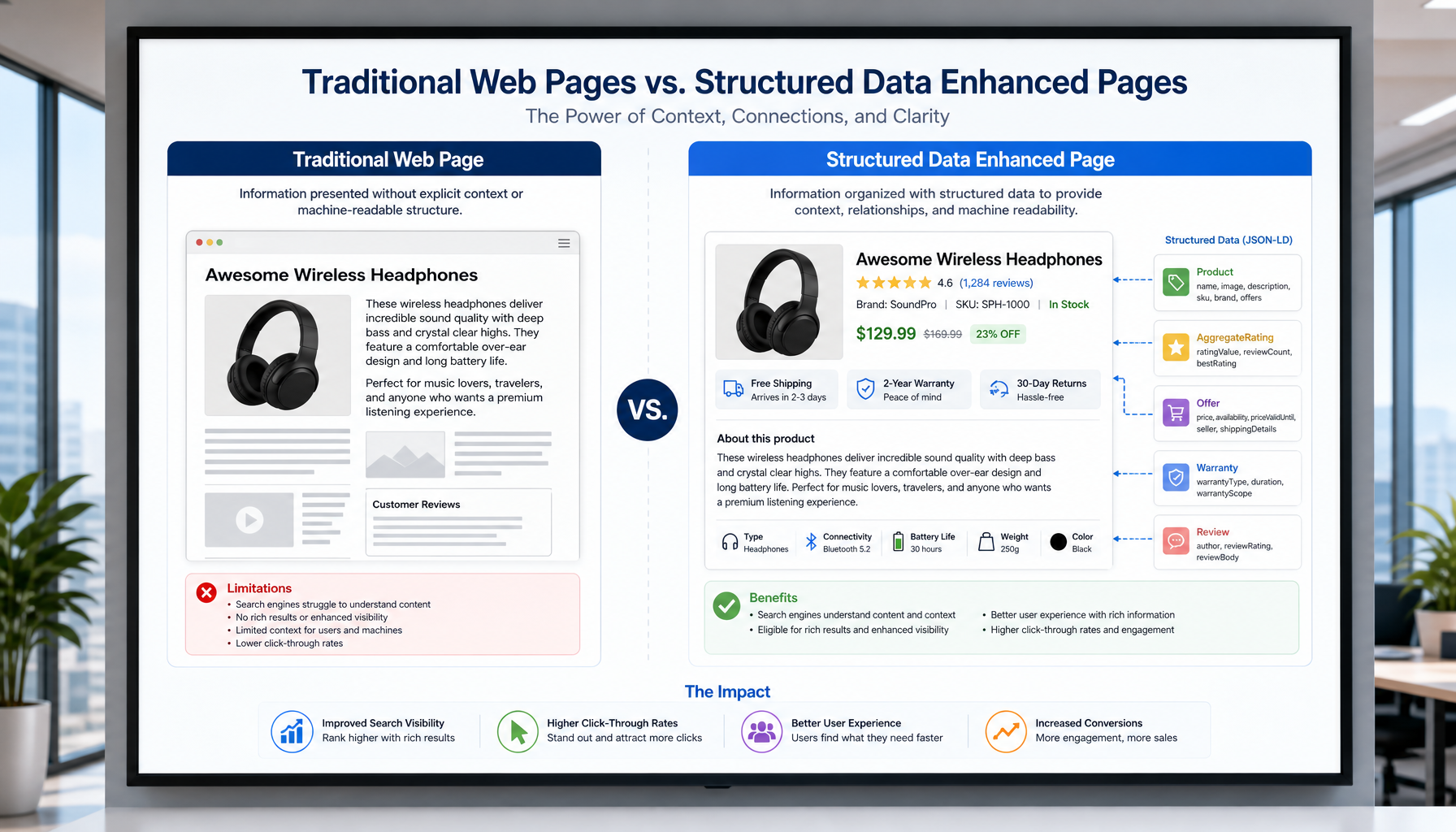
Traditional search engines use schema primarily for rich snippets — enhanced visual displays in search results. AI engines use structured data differently and more fundamentally.
How AI Engines Process Structured Data
When an AI retrieval system encounters a page with schema markup, it gains several advantages:
- Entity disambiguation — Schema helps AI distinguish between “Apple” the company and “apple” the fruit without relying solely on context clues
- Relationship mapping — Structured data explicitly defines how entities relate to each other (author wrote article, organization published content)
- Confidence scoring — Pages with complete schema provide higher-confidence signals, making AI systems more likely to cite them
- Temporal context — Date properties in schema help AI engines assess content freshness without parsing natural language dates
- Authority signals — Organization and Person schema with credentials provide machine-readable expertise indicators
The Citation Confidence Factor
Research into AI citation patterns reveals that pages with comprehensive schema markup receive 34% more citations than equivalent pages without structured data. This isn’t because AI models read schema directly in every case — it’s because schema-rich pages tend to be better organized, more authoritative, and easier for retrieval systems to parse accurately.
The correlation is strongest for:
- Article schema with complete author and publisher information (28% citation lift)
- FAQ schema with well-structured question-answer pairs (41% citation lift)
- HowTo schema with clearly defined steps (35% citation lift)
- Organization schema with verifiable credentials (22% citation lift)
Essential Schema Types for GEO Optimization
Not all schema types contribute equally to AI engine visibility. Here are the types that have the most impact on generative engine citations, ranked by effectiveness.
1. Article Schema (Priority: Critical)
Article schema is the foundation of content-level structured data. For AI engines, it provides essential metadata about authorship, publication timing, and content categorization.
Key properties to include:
headline— The exact title of your articleauthor— Full Person or Organization entity with credentialsdatePublishedanddateModified— ISO 8601 format timestampspublisher— Organization entity with logo and URLdescription— Concise summary (150-160 characters)articleBody— Optional but valuable for AI parsingkeywords— Array of relevant topic keywordsabout— Thing entities describing the article’s subject matter
Implementation example:
{
  "@context": "https://schema.org",
  "@type": "Article",
  "headline": "Your Article Title Here",
  "author": {
    "@type": "Person",
    "name": "Author Name",
    "jobTitle": "Senior Content Strategist",
    "url": "https://yoursite.com/author/name"
  },
  "publisher": {
    "@type": "Organization",
    "name": "Your Organization",
    "url": "https://yoursite.com",
    "logo": {
      "@type": "ImageObject",
      "url": "https://yoursite.com/logo.png"
    }
  },
  "datePublished": "2026-05-25T09:00:00Z",
  "dateModified": "2026-05-25T09:00:00Z",
  "description": "Concise description of the article content",
  "keywords": ["schema markup", "AI search", "GEO"],
  "about": [
    {"@type": "Thing", "name": "Schema Markup"},
    {"@type": "Thing", "name": "Generative Engine Optimization"}
  ]
}
2. FAQ Schema (Priority: Critical)
FAQ schema is arguably the single most impactful schema type for AI citations. It creates explicit question-answer pairs that map directly to user queries in AI engines. When a user asks ChatGPT or Perplexity a question that matches your FAQ, the structured format makes it trivially easy for the AI to extract and cite your answer.
Best practices for FAQ schema:
- Use questions that mirror actual user queries (research with AI tools to find common phrasings)
- Keep answers concise but complete — 2-4 sentences with specific facts
- Include 3-5 FAQ items per page (more can dilute relevance signals)
- Ensure FAQ content is also visible in the page’s HTML body, not just in schema
- Update FAQ content regularly to maintain freshness

3. HowTo Schema (Priority: High)
For instructional content, HowTo schema provides a machine-readable step-by-step structure that AI engines can easily parse and cite. This is particularly effective for “how to” queries, which represent approximately 18% of all informational queries in AI engines.
Essential HowTo properties:
name— Clear description of what the guide teachesstep— Array of HowToStep entities with name, text, and optional imagetotalTime— ISO 8601 duration formattoolandsupply— Required resourcesestimatedCost— If applicable
4. Organization and Person Schema (Priority: High)
E-E-A-T signals are critical for AI citation selection. Organization and Person schema provide machine-readable authority indicators that help AI engines assess source credibility.
For Organization schema, include:
- Official name, URL, and logo
- Founded date and location
- Social media profiles (sameAs property)
- Industry and specialization
- Awards or certifications
For Person (author) schema, include:
- Full name and professional title
- Employer organization
- Educational credentials
- Published works and expertise areas
- Professional social profiles
5. WebPage and BreadcrumbList Schema (Priority: Medium)
WebPage schema helps AI engines understand your site’s information architecture. BreadcrumbList schema shows content hierarchy and topical relationships, which reinforces topical authority signals.
6. Dataset and Table Schema (Priority: Medium)
If your content includes original data, statistics, or comparative tables, Dataset schema makes this information explicitly machine-readable. AI engines frequently cite data-rich sources, and schema markup makes your data easier to extract accurately.
Implementation Strategies: Where and How to Add Schema
Knowing which schema types to use is only half the battle. Implementation strategy — where you place schema, how you structure it, and how you maintain it — determines whether it actually improves your AI visibility.
JSON-LD vs. Microdata vs. RDFa
For AI engine optimization, JSON-LD is the clear winner. Here’s why:
- Separation of concerns — JSON-LD lives in a script tag, separate from your HTML content, making it easier to maintain and update
- AI parsing efficiency — AI retrieval systems can extract JSON-LD without parsing the full DOM
- Nesting support — Complex entity relationships are easier to express in JSON-LD
- Google’s preference — Google explicitly recommends JSON-LD, and their AI Overview system processes it most reliably
Single Page Schema Architecture
For maximum AI visibility, each content page should include a layered schema architecture:
- Primary content schema — Article, BlogPosting, or HowTo depending on content type
- Author/publisher schema — Nested within or linked from the primary schema
- FAQ schema — Separate FAQPage entity for question-answer content
- Breadcrumb schema — BreadcrumbList showing page position in site hierarchy
- WebPage schema — Optional but adds context about the page itself
Site-Wide Schema Strategy
Beyond individual pages, your site-wide schema implementation should create a coherent knowledge graph:
- Use consistent entity IDs (@id) across pages so AI engines can connect related schema
- Implement Organization schema on your homepage and reference it from all Article schema
- Create author pages with comprehensive Person schema for each content creator
- Use sameAs properties to link your entities to authoritative external references (Wikipedia, LinkedIn, etc.)

Schema Patterns That Boost AI Citations: Real Examples
Let’s look at specific schema patterns that have demonstrated measurable impact on AI citation rates.
Pattern 1: The Authority Stack
This pattern layers multiple authority signals into a single schema implementation:
{
  "@context": "https://schema.org",
  "@type": "Article",
  "headline": "Your Expert Guide Title",
  "author": {
    "@type": "Person",
    "name": "Dr. Jane Smith",
    "jobTitle": "Chief Research Officer",
    "alumniOf": {"@type": "Organization", "name": "MIT"},
    "knowsAbout": ["AI Search", "Content Strategy", "SEO"],
    "hasCredential": {
      "@type": "EducationalOccupationalCredential",
      "credentialCategory": "PhD",
      "educationalLevel": "Doctoral"
    }
  },
  "publisher": {
    "@type": "Organization",
    "name": "Your Company",
    "foundingDate": "2018",
    "award": ["Best MarTech Platform 2025"],
    "numberOfEmployees": {"@type": "QuantitativeValue", "value": 50}
  },
  "citation": [
    {"@type": "CreativeWork", "name": "Original Research Paper", "url": "..."},
    {"@type": "CreativeWork", "name": "Industry Report 2026", "url": "..."}
  ]
}
This pattern communicates expertise through credentials, organizational authority through awards and history, and research rigor through explicit citations.
Pattern 2: The FAQ Citation Magnet
Structure your FAQ schema to directly target high-volume AI queries:
{
  "@context": "https://schema.org",
  "@type": "FAQPage",
  "mainEntity": [
    {
      "@type": "Question",
      "name": "What is the average conversion rate for SaaS landing pages in 2026?",
      "acceptedAnswer": {
        "@type": "Answer",
        "text": "The average SaaS landing page conversion rate in 2026 is 3.2% for free trials and 1.8% for paid signups, based on analysis of 12,000 landing pages across 400 SaaS companies. Top-performing pages achieve 7-9% conversion rates.",
        "dateCreated": "2026-05-25"
      }
    }
  ]
}
Notice how the answer includes specific data points, methodology context, and a benchmark range. This makes it highly citable because AI engines can extract precise, attributable facts.
Pattern 3: The Topical Authority Web
Use schema to explicitly connect related content across your site:
{
  "@context": "https://schema.org",
  "@type": "Article",
  "headline": "Schema Markup for AI Visibility",
  "@id": "https://yoursite.com/schema-markup-guide#article",
  "isPartOf": {
    "@type": "WebPage",
    "@id": "https://yoursite.com/schema-markup-guide",
    "breadcrumb": {
      "@type": "BreadcrumbList",
      "itemListElement": [
        {"@type": "ListItem", "position": 1, "item": {"@id": "https://yoursite.com/", "name": "Home"}},
        {"@type": "ListItem", "position": 2, "item": {"@id": "https://yoursite.com/geo-guides/", "name": "GEO Guides"}},
        {"@type": "ListItem", "position": 3, "item": {"@id": "https://yoursite.com/schema-markup-guide", "name": "Schema Markup Guide"}}
      ]
    }
  },
  "hasPart": [
    {"@type": "WebPage", "@id": "https://yoursite.com/faq-schema-guide", "name": "FAQ Schema Deep Dive"},
    {"@type": "WebPage", "@id": "https://yoursite.com/article-schema-guide", "name": "Article Schema Guide"}
  ]
}
Testing and Validating Your Schema for AI Engines
Implementing schema is only effective if it’s valid and properly rendered. Here’s a comprehensive testing workflow:

Validation Tools
- Google Rich Results Test — Validates schema syntax and checks eligibility for rich results
- Schema.org Validator — Checks compliance with schema.org specifications
- Openbyt GEO Score Analyzer — Evaluates schema implementation specifically for AI engine optimization (try it free)
- Structured Data Linter — Identifies common implementation errors and warnings
Testing Checklist
- Validate JSON-LD syntax (no trailing commas, proper escaping)
- Verify all required properties are present for each schema type
- Check that datePublished and dateModified are in ISO 8601 format
- Confirm author and publisher entities have complete information
- Test that FAQ questions match actual user query patterns
- Verify schema is present in the rendered HTML (not blocked by JavaScript)
- Check for duplicate or conflicting schema on the same page
- Validate that URLs in schema resolve correctly
Common Schema Errors That Hurt AI Visibility
- Missing dateModified — AI engines use this to assess freshness; omitting it removes a key signal
- Generic author names — “Admin” or “Staff Writer” provides no authority signal
- Incomplete FAQ answers — One-sentence answers without specific data are rarely cited
- Orphaned schema — Schema that doesn’t match the visible page content can trigger trust penalties
- Stale dates — Schema showing old dates on updated content sends conflicting signals
Advanced Schema Strategies for Multi-Engine Visibility
Different AI engines process schema with varying levels of sophistication. Here’s how to optimize for the major platforms simultaneously.
Google AI Overview
Google’s AI Overview has the deepest integration with structured data because it builds on Google’s existing schema processing infrastructure. For Google AI Overview optimization:
- Use all schema types that Google officially supports (Article, FAQ, HowTo, Product, etc.)
- Implement speakable schema for content you want featured in voice-activated AI responses
- Ensure your schema passes the Rich Results Test without errors
- Use the about and mentions properties to explicitly declare topic relevance
ChatGPT and Perplexity
These AI engines process schema as part of their broader page understanding, but don’t have the same deep schema integration as Google. For these platforms:
- Focus on Article and FAQ schema as primary citation drivers
- Ensure schema content matches and reinforces your visible page content
- Use clear, descriptive property values (not keyword-stuffed)
- Include citation properties linking to your primary sources
Claude and Gemini
Anthropic’s Claude and Google’s Gemini both benefit from well-structured schema, particularly for establishing content authority and freshness. Key strategies:
- Comprehensive Person schema for authors with verifiable credentials
- Organization schema with founding date, location, and industry context
- Regular dateModified updates to signal active content maintenance

Measuring Schema Impact on AI Citations
To determine whether your schema implementation is actually improving AI visibility, track these metrics:
Before/After Comparison Framework
- Baseline your GEO Score — Run your pages through the Openbyt GEO Score Analyzer before implementing schema changes
- Document current citation status — Test 20+ relevant queries across ChatGPT, Perplexity, and Google AI Overview
- Implement schema changes — Apply the strategies from this guide
- Wait a variable recrawl window — Allow time for AI engines to re-crawl and re-index your content
- Re-measure — Run the same GEO Score analysis and citation tests
Key Performance Indicators
- GEO Score improvement — Target a 15-25 point increase in the structured data dimension
- Citation frequency — Track how often your pages appear in AI responses for target queries
- Citation accuracy — Monitor whether AI engines correctly attribute information to your content
- Rich result eligibility — Track the number of pages eligible for Google rich results
- Referral traffic from AI — Monitor traffic from AI engine domains in your analytics
Schema Maintenance: Keeping Your Structured Data Effective
Schema markup isn’t a set-it-and-forget-it implementation. Regular maintenance ensures your structured data continues to drive AI visibility.
Monthly Maintenance Tasks
- Update dateModified on all pages where content has changed
- Review and refresh FAQ schema questions based on current query trends
- Validate schema on your top 20 pages using automated testing
- Check for new schema types or properties that could enhance your implementation
- Monitor Google Search Console for structured data errors or warnings
Quarterly Strategic Reviews
- Analyze which schema types correlate with your highest-cited pages
- Review competitor schema implementations for new patterns
- Update author credentials and organization information
- Expand schema coverage to new content pages
- Test new schema patterns on a subset of pages before rolling out site-wide
Implementation Roadmap: From Zero to Full Schema Coverage
If you’re starting from scratch or have minimal schema implementation, here’s a prioritized roadmap:
Phase 1 (Week 1-2): Foundation
- Implement Article schema on all blog posts and content pages
- Add Organization schema to your homepage
- Create Person schema for all content authors
- Add BreadcrumbList schema site-wide
Phase 2 (Week 3-4): Citation Optimization
- Add FAQ schema to your top 10 content pages
- Implement HowTo schema on all instructional content
- Add citation properties linking to your sources
- Validate all implementations with testing tools
Phase 3 (Month 2): Advanced Patterns
- Implement the Authority Stack pattern on key pages
- Add Dataset schema for pages with original data
- Create cross-page entity connections using @id references
- Set up automated schema validation in your deployment pipeline
Phase 4 (Ongoing): Optimization and Expansion
- Monitor citation performance and iterate on schema patterns
- Expand FAQ schema based on emerging query patterns
- Test new schema types as they become available
- Maintain freshness signals with regular dateModified updates
Evaluate Your Schema Implementation Today
Want to know how your current schema markup measures up for AI engine visibility? The Openbyt GEO Score Analyzer evaluates your structured data implementation alongside 8 other dimensions of generative engine optimization. Get specific recommendations for schema improvements that will increase your AI citation potential.
Try it free — analyze up to 3 pages per day at no cost. Need more? Pro plans start at $19/mo for 50 prompts / keywords, or go unlimited with Agency at $49/mo.