
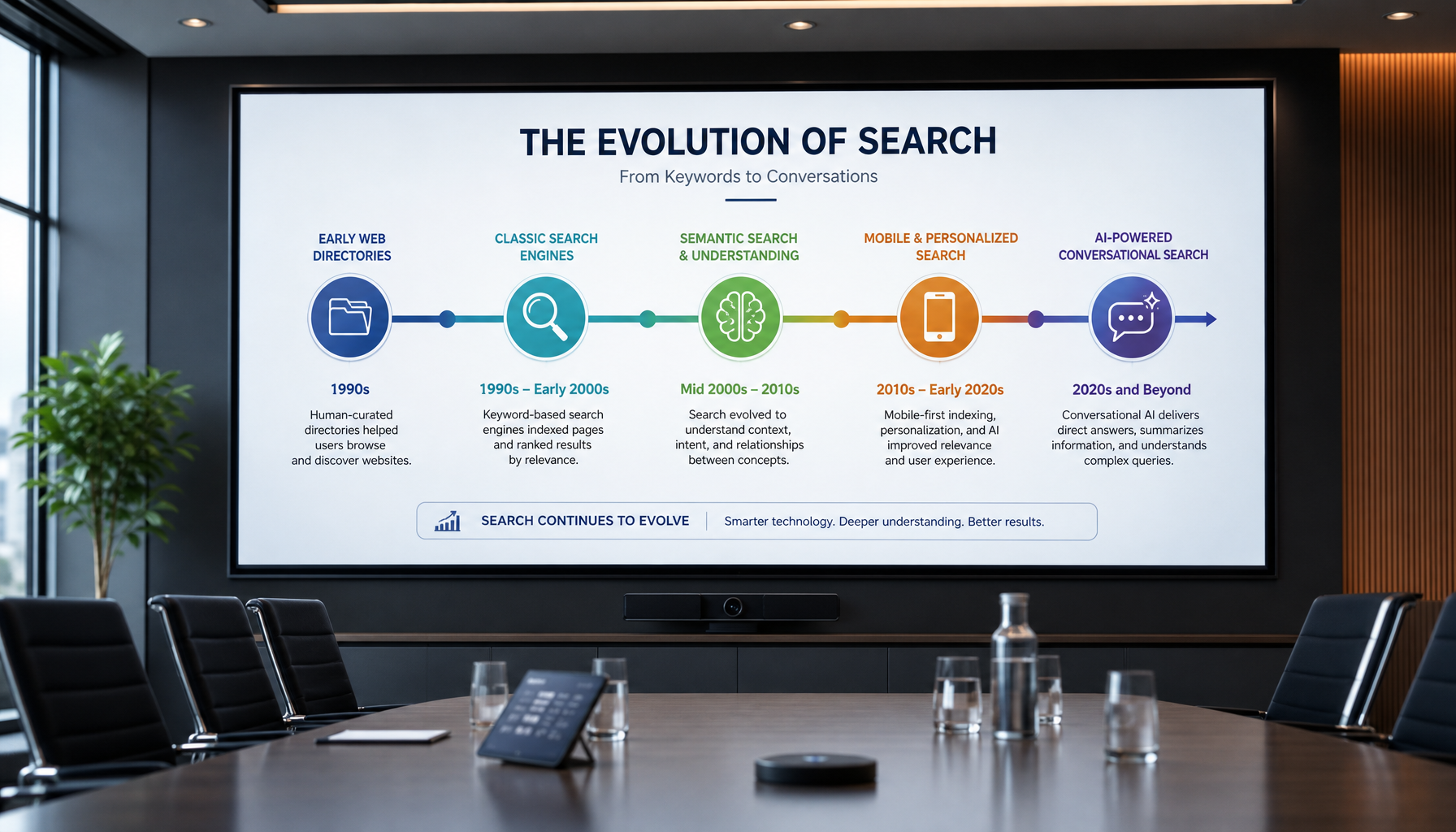
GEO (Generative Engine Optimization) and SEO (Search Engine Optimization) are no longer the same discipline. While they share DNA, the rise of AI-powered search engines in 2025 and 2026 has split them into distinct practices with different goals, different signals, and different measurement frameworks. If you are still treating AI search visibility as a subset of traditional SEO, you are leaving citations and traffic on the table.
This guide maps the differences between GEO and SEO as they stand in 2026. We will cover how each discipline defines success, what ranking and citation signals matter, how content strategy diverges, what technical requirements differ, and how to build a unified approach that serves both. Whether you are a content marketer, an SEO specialist, or a product team trying to understand where to invest, this breakdown will give you a clear picture of the landscape.
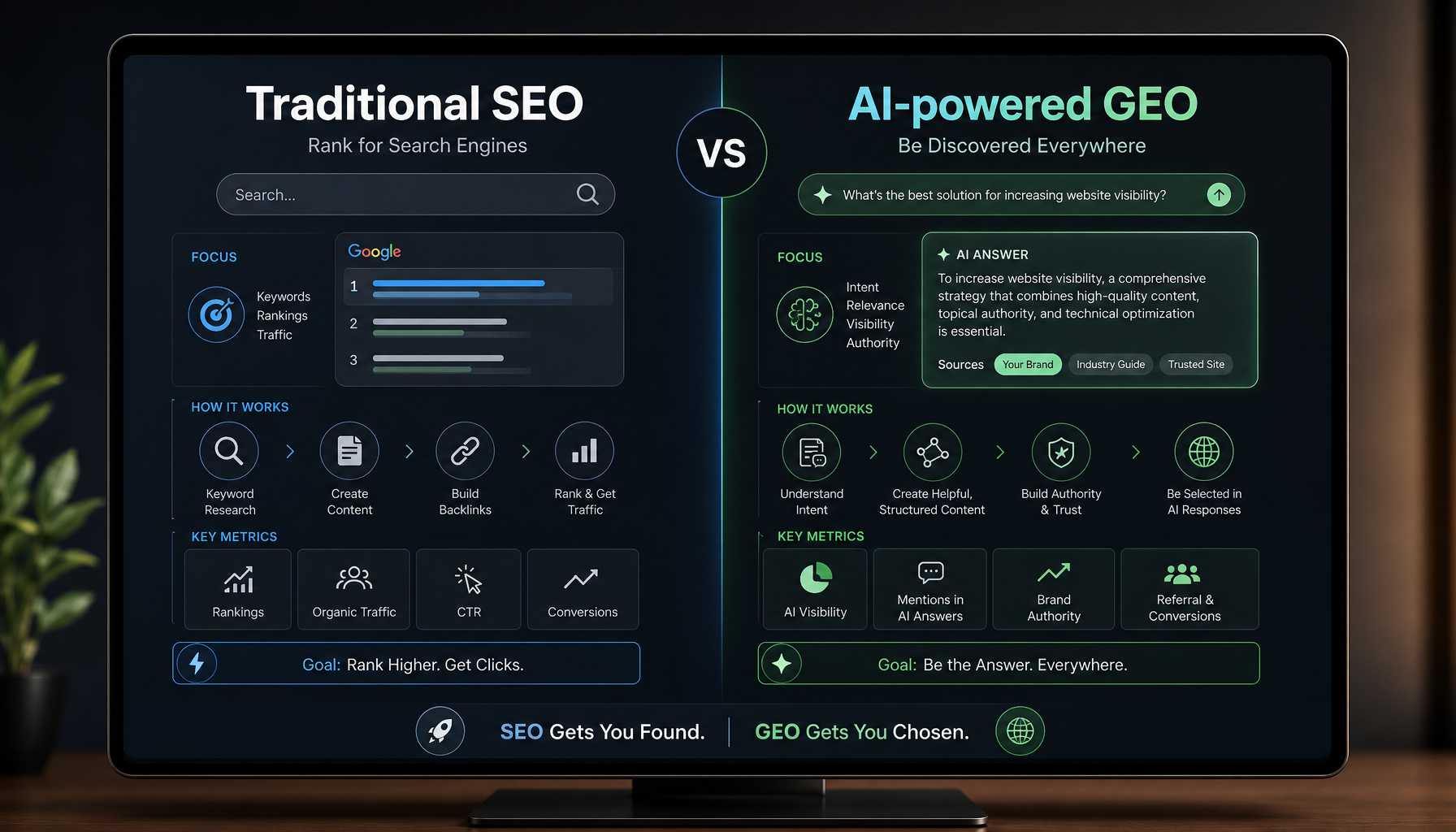
Defining the Two Disciplines
Before diving into differences, let us establish clear definitions as they apply in 2026.
SEO is the practice of optimizing web content and technical infrastructure to rank higher in traditional search engine results pages (SERPs). The goal is to earn organic clicks from users scanning a list of results. Success is measured in rankings, impressions, click-through rates, and organic sessions.
GEO is the practice of optimizing content to be cited, referenced, or surfaced by generative AI search engines, including ChatGPT, Perplexity, Google AI Overview, Claude, and Gemini. The goal is to become a source that AI engines trust enough to cite when generating answers. Success is measured in citation frequency, citation position, referral traffic from AI engines, and brand visibility within AI-generated responses.
The two disciplines overlap significantly, but the divergence is growing. A page can rank first in Google organic results and never be cited in AI Overview. Conversely, a page can be cited by Perplexity and ChatGPT without ranking in the top ten for any traditional keyword.
How Success Is Defined Differently
SEO Success Metrics
Traditional SEO measures success through a well-established stack of metrics:
- Keyword rankings (position 1 through 10 for target terms)
- Organic impressions and clicks from Google Search Console
- Click-through rate from SERP to page
- Organic sessions and conversions in analytics
- Domain authority and backlink profile growth
- Page speed and Core Web Vitals scores
These metrics are mature, well-tooled, and directly tied to revenue for most content-driven businesses.
GEO Success Metrics
GEO introduces a different measurement layer:
- Citation frequency: how often your domain is cited across priority queries in AI engines
- Citation position: whether you are cited first, second, or further down in the answer
- Citation breadth: how many distinct queries trigger citations to your content
- AI referral traffic: sessions originating from AI engine citation clicks
- Brand mention rate: how often your brand appears in AI-generated answers, even without a direct link
- GEO Score: composite scores from tools like the Openbyt GEO Score Analyzer that evaluate content readiness across multiple dimensions
The key difference is that GEO success is not binary (ranked or not ranked). It is probabilistic and contextual. The same page might be cited for one query phrasing and not another, or cited by Perplexity but not by ChatGPT. Measurement requires broader coverage and more frequent auditing.
Ranking Signals vs Citation Signals
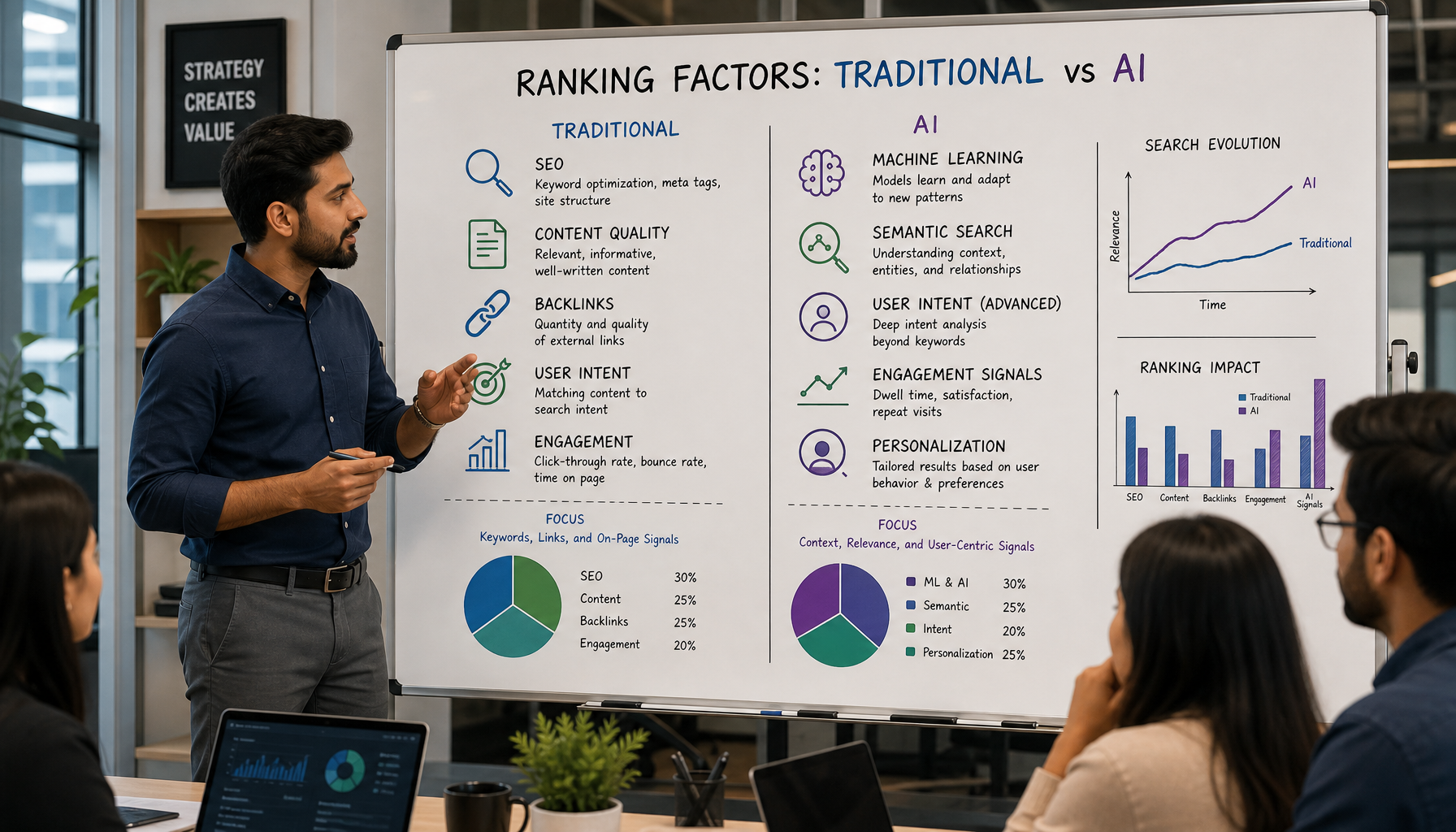
This is where the disciplines diverge most sharply. While there is overlap, the weight and nature of signals differ significantly.
Signals That Matter More for SEO
- Backlink profile. The quantity and quality of inbound links remains the strongest traditional ranking signal. AI engines use authority signals too, but they are less dependent on raw link counts.
- Keyword optimization. Title tags, meta descriptions, and keyword placement in headings still drive traditional rankings. AI engines care more about semantic coverage than keyword density.
- Click-through rate signals. Google uses engagement data from SERPs to adjust rankings. AI engines do not have an equivalent feedback loop from their citation interfaces.
- Page experience signals. Core Web Vitals, mobile-friendliness, and interstitial penalties directly affect traditional rankings. AI engines care about crawlability but are less sensitive to UX metrics.
- Exact match domains and URL structure. These still carry modest weight in traditional search but appear irrelevant to AI citation selection.
Signals That Matter More for GEO
- Factual density. AI engines strongly prefer content packed with specific, verifiable claims. Traditional SEO rewards this too, but not as directly.
- Passage-level relevance. AI engines extract and evaluate individual passages, not just whole pages. A single highly relevant paragraph can earn a citation even if the rest of the page is mediocre.
- Structured extractability. Content that is easy to chunk into coherent passages, with clear headings, short paragraphs, and well-formed lists, gets cited more often.
- Direct answer format. Leading with a clear, quotable answer to the implied question is critical for GEO. Traditional SEO often rewards longer introductions that build context.
- Topical authority depth. AI engines evaluate whether a domain consistently publishes authoritative content within a topic cluster, not just whether a single page is strong.
- Schema markup for AI. Article schema, FAQ schema, and HowTo schema help AI engines understand content structure and extract answers more reliably.
- Source diversity signals. AI engines prefer to cite diverse sources. Being the only authoritative voice on a niche topic gives you an advantage that does not exist in traditional SEO.
Signals That Matter for Both
- Content quality and depth
- E-E-A-T (Experience, Expertise, Authoritativeness, Trustworthiness)
- Crawlability and technical accessibility
- Content freshness and update signals
- Domain reputation and trust
Content Strategy: How the Approach Differs

SEO Content Strategy in 2026
Traditional SEO content strategy still revolves around keyword research, search volume, and competitive gap analysis. The workflow typically looks like:
- Identify target keywords with meaningful search volume
- Analyze SERP competition and content gaps
- Create content that matches or exceeds the depth and quality of ranking pages
- Optimize on-page elements (title, meta, headings, internal links)
- Build backlinks to strengthen page and domain authority
- Monitor rankings and iterate
This approach still works for traditional organic traffic. But it does not directly address AI citation visibility.
GEO Content Strategy in 2026
GEO content strategy starts from a different premise: what questions are users asking AI engines, and what kind of answer does the engine need to construct a response?
- Identify priority queries that users are asking AI engines (not just traditional search)
- Analyze what sources are currently being cited for those queries across multiple AI engines
- Identify gaps in the cited content: what information is missing, outdated, or poorly structured
- Create content that fills those gaps with high factual density, clear structure, and direct answers
- Implement schema markup that helps AI engines parse and extract your content
- Build topical authority through consistent, deep coverage of your subject area
- Monitor citation rates across engines and iterate
The fundamental shift is from “what keywords should I target” to “what answers should I be the best source for.” This is a subtle but important reframing that changes how you plan, write, and measure content.
Where the Strategies Converge
Despite the differences, the best content strategies in 2026 serve both disciplines simultaneously. High-quality, well-structured, authoritative content that answers real questions tends to perform well in both traditional search and AI citations. The divergence is mostly in emphasis and measurement, not in fundamental quality standards.
Technical Requirements: What’s Different

Technical SEO Essentials (Still Relevant)
- XML sitemaps and proper crawl management
- Canonical tags and duplicate content handling
- Core Web Vitals optimization
- Mobile-first responsive design
- Structured data for rich snippets (Product, Review, Breadcrumb)
- Internal linking architecture
- HTTPS and security headers
Technical GEO Requirements (New or Elevated)
- AI bot access. Ensure robots.txt allows crawlers from Perplexity (PerplexityBot), ChatGPT (GPTBot), Google (Googlebot), and others. Some sites inadvertently block AI crawlers while allowing traditional search bots.
- Server-side rendering. AI crawlers are less likely to execute JavaScript than Googlebot. Content that requires client-side rendering may be invisible to AI engines.
- Article and FAQ schema. While traditional SEO uses schema for rich snippets, GEO relies on schema to help AI engines understand content structure, authorship, and freshness.
- Clean HTML structure. AI passage extractors work best on semantic HTML with proper heading hierarchy, paragraph tags, and list elements. Div-soup layouts with CSS-only structure are harder to parse.
- Consistent update signals. dateModified in schema, visible “last updated” dates, and changelog sections help AI engines assess freshness without relying solely on crawl frequency.
- API and feed accessibility. Some AI engines can consume structured feeds (RSS, JSON-LD feeds) more efficiently than crawling individual pages. Making your content available through multiple channels increases retrieval probability.
Measurement and Tools: The Tooling Gap
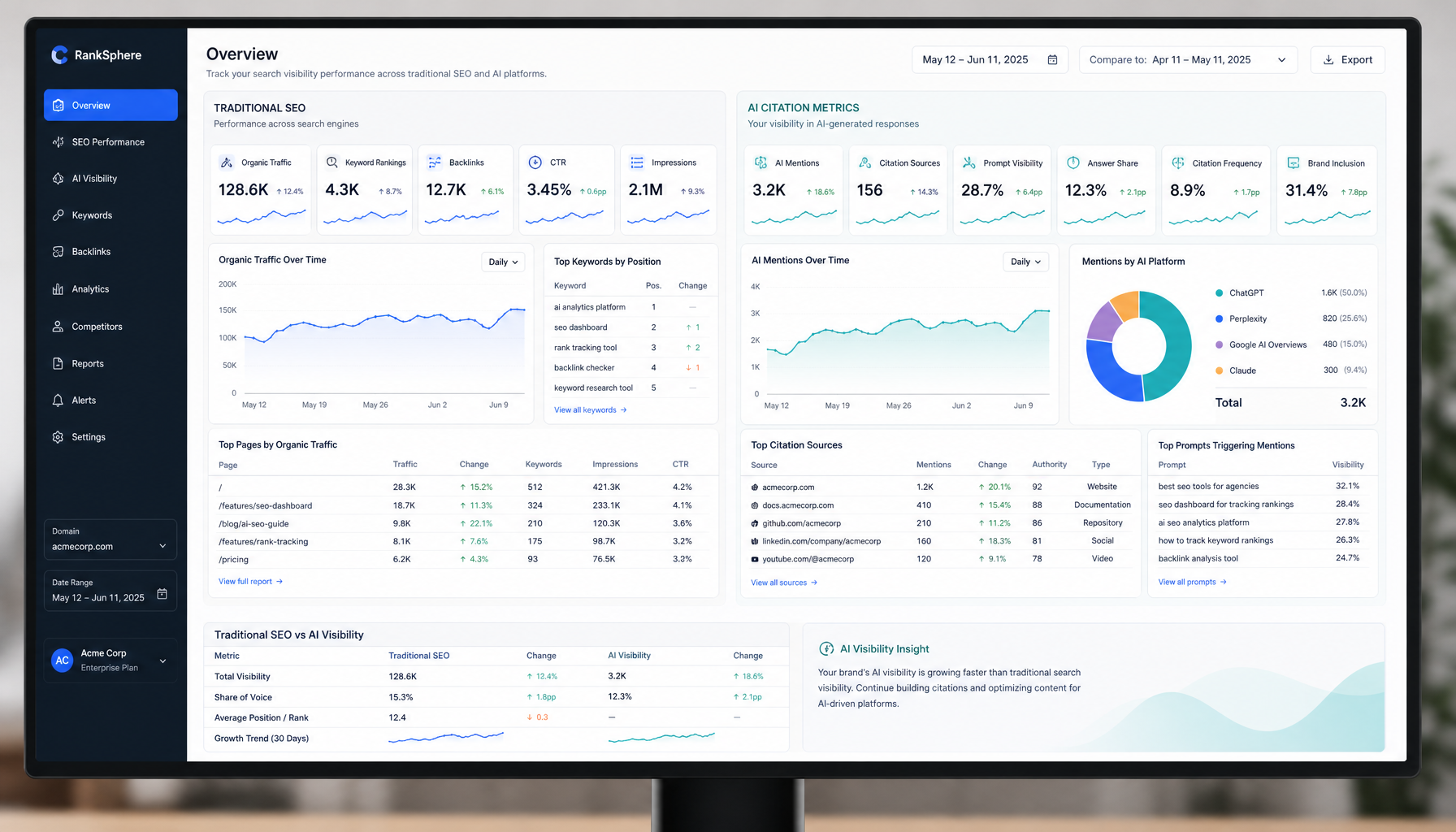
One of the biggest practical differences between SEO and GEO in 2026 is the maturity of measurement tools.
SEO Tooling (Mature)
SEO has decades of tooling investment. Google Search Console, Ahrefs, SEMrush, Moz, Screaming Frog, and dozens of other tools provide comprehensive data on rankings, backlinks, technical health, and competitive positioning. The data is reliable, granular, and actionable.
GEO Tooling (Emerging)
GEO tooling is still in its early stages but maturing rapidly. The current landscape includes:
- GEO Score analyzers. Tools like Openbyt’s GEO Score Analyzer evaluate content against the nine dimensions known to influence AI citations, providing actionable scores and recommendations before you publish.
- Citation tracking services. Emerging platforms that monitor AI engine outputs for brand mentions and source citations across multiple engines.
- AI referral analytics. Standard analytics platforms now segment traffic from AI engines, though attribution is still imperfect.
- Query auditing tools. Services that systematically run priority queries across AI engines and track citation changes over time.
The tooling gap means GEO practitioners need to be more hands-on with measurement than SEO practitioners. Manual auditing, custom tracking, and composite scoring are still necessary to get a complete picture.
Building a Unified Strategy

The most effective approach in 2026 is not to choose between SEO and GEO but to build a unified strategy that serves both. Here is a practical framework:
Step 1: Audit Both Channels
Start by understanding your current performance in both traditional search and AI citations. Run your priority pages through both traditional SEO audits and GEO scoring tools. Identify where you are strong in one channel but weak in the other.
Step 2: Identify Shared Wins
Many optimizations serve both channels simultaneously. Improving content depth, adding structured data, strengthening topical authority, and updating stale content all benefit traditional rankings and AI citation rates. Prioritize these shared wins first.
Step 3: Address GEO-Specific Gaps
After shared wins, focus on GEO-specific optimizations that do not conflict with SEO:
- Add direct-answer leads to articles that currently use narrative introductions
- Convert subheadings to question format where natural
- Add FAQ sections with schema markup
- Ensure AI bot access in robots.txt
- Implement Article schema with author and date fields
Step 4: Measure Holistically
Track both traditional SEO metrics and GEO metrics in a unified dashboard. Look for correlations: do pages that improve in GEO score also improve in traditional rankings? In most cases, the answer is yes, which validates the unified approach.
Step 5: Iterate Based on Data
As GEO tooling matures and AI engines evolve, the balance between SEO and GEO will shift. Build a measurement cadence that lets you detect changes early and adjust strategy accordingly. Monthly citation audits combined with weekly ranking checks give most teams sufficient signal.
What This Means for Teams and Budgets
The practical implication for marketing and content teams is that GEO is not a replacement for SEO. It is an additional layer that requires incremental investment in:
- Skills. Understanding AI engine behavior, structured data implementation, and citation measurement.
- Tools. GEO scoring and citation tracking alongside traditional SEO platforms.
- Process. Adding GEO review steps to content workflows, including pre-publish scoring and post-publish citation monitoring.
- Content. Slightly different content formats that serve AI extraction while maintaining readability for human visitors.
Teams that treat GEO as a natural extension of their existing SEO practice, rather than a separate initiative, tend to see faster results with lower overhead.
Frequently Asked Questions
Is SEO dead because of AI search?
No. Traditional organic search still drives the majority of web traffic in 2026. AI search is growing rapidly and taking share, but it has not replaced traditional search. The smart move is to optimize for both channels rather than abandoning either one.
Can I do GEO without doing SEO?
Technically yes, but it is inefficient. Many GEO signals overlap with SEO best practices. A site with strong technical SEO foundations, good content quality, and established domain authority has a significant head start in GEO. Starting from scratch on GEO without SEO fundamentals means rebuilding work that SEO would have already addressed.
Which AI engines should I prioritize for GEO?
In 2026, the highest-impact engines for most content creators are Google AI Overview (largest user base), Perplexity (highest citation click-through rates), and ChatGPT (broadest reach among knowledge workers). The good news is that optimization for one tends to benefit all three, since they reward similar content qualities.
How quickly can I see results from GEO optimization?
GEO results can appear faster than traditional SEO results because AI engines re-index and re-evaluate content more frequently than traditional search crawlers. Teams typically see measurable citation improvements within two to six weeks of implementing structural and content changes, compared to three to six months for traditional SEO ranking improvements.
Do I need separate content for SEO and GEO?
No. The best approach is to create single pieces of content that serve both channels. The optimizations that help GEO, such as direct answers, structured headings, FAQ sections, and factual density, also tend to improve traditional SEO performance. You do not need duplicate content strategies.
The Timeline: How Fast Is the Shift Happening?
Understanding the pace of change helps teams prioritize investment. Here is what the data shows about the SEO-to-GEO transition in 2026:
- AI search usage growth: AI-powered search tools are used by an estimated 35% to 45% of knowledge workers daily in 2026, up from under 15% in early 2024.
- Traffic share shift: For informational queries, AI engines now account for 10% to 20% of total referral traffic for content-heavy sites, up from negligible levels two years ago.
- Google AI Overview expansion: AI Overviews now appear on approximately 40% of informational queries in Google, up from limited testing in 2024.
- Enterprise adoption: Over 60% of enterprise content teams report having some form of GEO initiative in 2026, though most are still in early stages.
The shift is not hypothetical or future-tense. It is happening now, and the pace is accelerating. Teams that wait for GEO to “mature” before investing are already falling behind teams that started optimizing in 2025.
Common Misconceptions About GEO vs SEO
Several misconceptions persist about the relationship between GEO and SEO. Clearing these up helps teams make better strategic decisions:
Misconception: GEO will replace SEO entirely
Reality: Traditional search still drives the majority of web traffic. AI search is additive, not replacement. Both channels will coexist for the foreseeable future, and the best strategies serve both.
Misconception: If I rank well in Google, I will automatically get AI citations
Reality: While there is correlation, it is far from guaranteed. Many top-ranking pages are not cited by AI engines because their content structure, factual density, or passage extractability does not meet AI requirements. Conversely, pages outside the top 10 can earn citations through superior content quality.
Misconception: GEO requires completely different content
Reality: The same content can serve both channels when structured correctly. The optimizations that help GEO, such as direct answers, clear structure, and factual density, also tend to improve traditional SEO performance. You do not need separate content strategies.
Misconception: Only big brands can earn AI citations
Reality: AI engines, particularly Perplexity, frequently cite smaller specialized sites when they offer the best answer for a query. Topical authority and content quality matter more than brand size for many query types.
Practical Examples: How a Single Page Looks Different for SEO vs GEO
Theory becomes clearer with concrete examples. Consider a hypothetical article titled “How to Choose a Project Management Tool for Remote Teams.” Here is how the same article would look optimized for traditional SEO versus optimized for both SEO and GEO.
SEO-Only Approach
The article opens with an engaging anecdote about a struggling remote team. It builds toward a list of recommendations through 1,500 words of narrative. Keywords appear naturally throughout. The title tag and meta description are optimized for “best project management tools for remote teams.” The page has a strong internal link from a related cornerstone article.
This article will likely rank well in traditional search if the domain has authority and the content is genuinely useful. However, AI engines may struggle to extract clean passages because the answers are scattered throughout narrative text.
GEO-Optimized Approach
The same article opens with a direct answer summary: “The best project management tools for remote teams in 2026 are Linear (for engineering teams), Asana (for cross-functional teams), and ClickUp (for budget-conscious teams). Each excels in different scenarios, detailed below.” Subsequent sections use clear H2 and H3 headings that match likely user queries: “What features matter most for remote teams?” “How much should remote teams expect to pay for project management tools?” “When is a free tool sufficient versus a paid one?”
An FAQ section addresses follow-up questions. Schema markup makes the structure explicit. The same narrative engagement can exist within sections, but the structural skeleton makes passage extraction trivial.
The GEO-optimized version typically performs equally well or better in traditional search while substantially outperforming for AI citations. The structural changes do not sacrifice readability; they enhance it.
Moving Forward: The Unified Approach
The distinction between GEO and SEO will likely blur further as traditional search engines continue integrating AI features and AI engines continue improving their retrieval capabilities. The teams that thrive will be those who understand both disciplines deeply enough to optimize for the shared fundamentals while adapting to the unique requirements of each channel.
Start by assessing where your content stands today. The Openbyt GEO Score Analyzer gives you a clear baseline across the nine dimensions that matter most for AI citation readiness. Run your top pages through the free tier to identify your biggest opportunities, then use the framework in this guide to prioritize improvements.
For teams ready to scale their GEO efforts, our Starter and Pro plans provide batch analysis, API access, and Pro monitoring capacity to integrate GEO scoring directly into your content workflow.
The future of search is not SEO or GEO. It is both, working together. The sooner you build that unified capability, the stronger your position across every search surface that matters.
Find more in-depth guides on AI search optimization at the Openbyt blog.
Try the Free GEO Score Analyzer
See how your content performs against 9 dimensions that AI engines evaluate when selecting sources to cite. The Openbyt GEO Score Analyzer is free to use, with three analyses per day on the free tier.
Need more analyses or API access? Check our pricing or browse more GEO guides on the blog.