

The way AI search engines process and cite content is fundamentally different from how traditional search engines rank pages. While Google’s classic algorithm focused heavily on backlinks and keyword density, generative AI engines like ChatGPT, Perplexity, Google AI Overview, and Claude prioritize content that is well-structured, clearly organized, and easy to parse programmatically.
If your content lacks clear structural patterns, AI engines will skip over it in favor of competitors who make their information accessible and digestible. This guide breaks down the exact content structure patterns that AI engines prefer when selecting sources to cite in their responses.
Why Content Structure Matters More Than Ever for AI Citations
Traditional SEO taught us that structure matters for user experience and crawlability. But for generative engine optimization (GEO), structure serves a different and more critical purpose: it helps AI models identify, extract, and attribute specific pieces of information to your content.
When an AI engine processes your page, it doesn’t read it like a human. It parses the content into semantic chunks, evaluates the relevance and authority of each chunk, and then decides whether to cite your page as a source. Content that is poorly structured creates friction in this process, making it harder for the AI to confidently attribute information to your page.
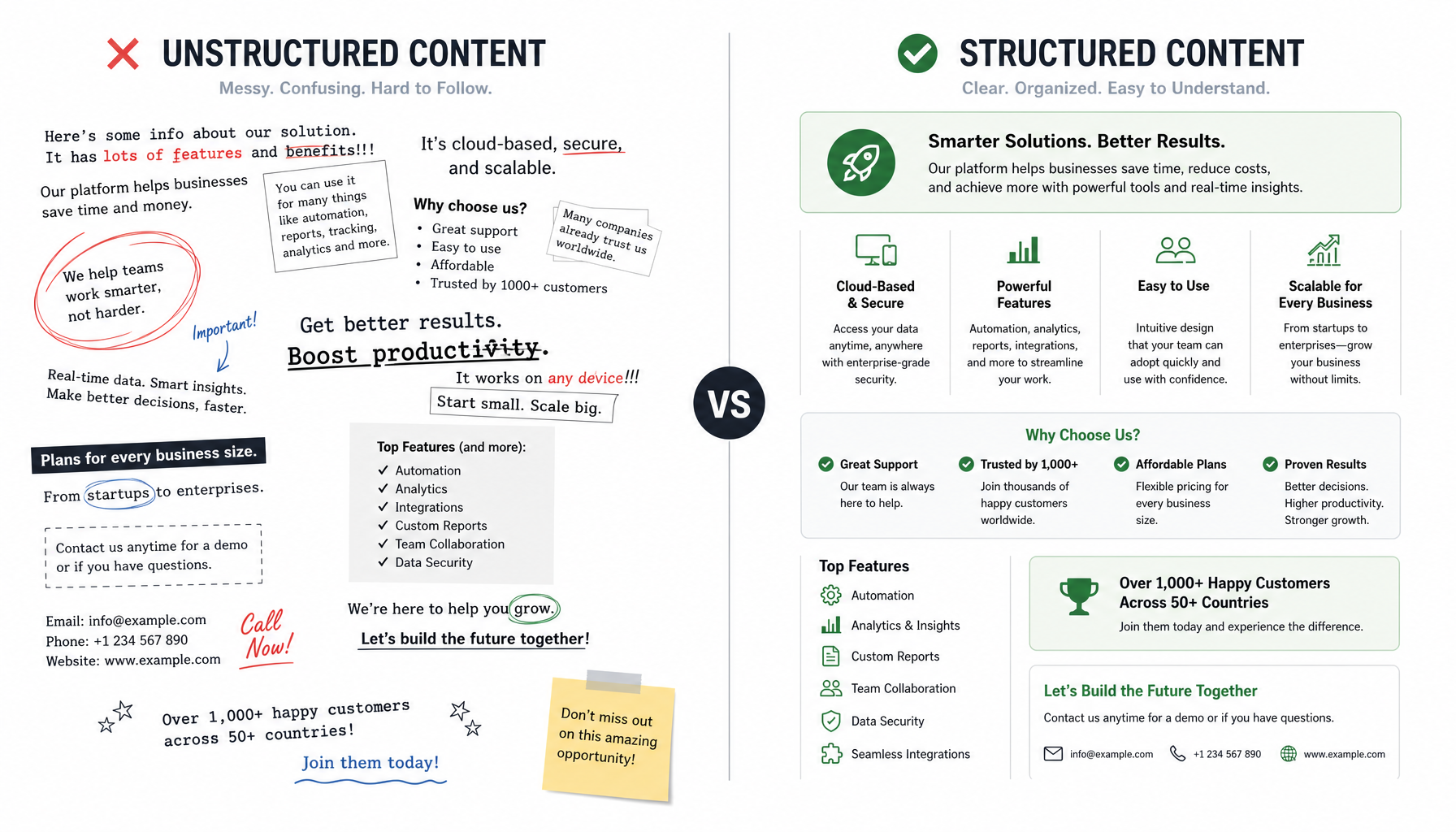
Research from multiple GEO studies in 2025 and 2026 shows that pages with clear hierarchical structure receive 40-60% more AI citations than pages with equivalent information but poor organization. The structure itself becomes a trust signal that tells AI engines: this content is authoritative, well-researched, and reliable enough to cite.
The Hierarchical Heading Pattern
The most fundamental structural pattern is a clean heading hierarchy. AI engines use headings as semantic markers to understand the topical scope and depth of your content. Here’s what works:
Single H1 Rule
Every page should have exactly one H1 tag that clearly states the primary topic. AI engines use this as the anchor point for understanding what your page is about. Multiple H1 tags create ambiguity about the page’s primary focus.
Descriptive H2 Sections
Your H2 headings should function as complete topic statements, not clever or vague labels. Instead of “The Basics,” use “How AI Engines Parse Content Structure.” AI models match user queries against your headings, so descriptive headings dramatically increase your chances of being cited for relevant queries.
H3 for Granular Subtopics
Use H3 headings to break complex sections into digestible subtopics. This gives AI engines more precise extraction points. When a user asks a specific question, the AI can pull from a targeted H3 section rather than trying to extract from a large, undifferentiated block of text.
Avoid Skipping Levels
Never jump from H2 to H4 or from H1 to H3. AI engines interpret heading levels as a semantic hierarchy. Skipping levels suggests disorganized thinking and reduces the AI’s confidence in your content’s reliability.

The Definition-First Pattern
AI engines frequently need to answer “what is” questions. Pages that lead with clear, concise definitions before expanding into detail get cited significantly more often for definitional queries.
The pattern works like this:
- Lead with a one-sentence definition immediately after the relevant heading
- Follow with a 2-3 sentence expansion that adds context
- Then provide detailed explanation with examples and nuance
This inverted pyramid approach mirrors how AI engines extract information. They look for the most concise, authoritative statement first, then pull additional context if needed. If your definition is buried in paragraph three of a section, the AI may never reach it or may find a competitor’s definition more accessible.
For example, if you’re writing about GEO, don’t start with the history of search engines. Start with: “Generative Engine Optimization (GEO) is the practice of optimizing content to increase visibility and citation rates in AI-powered search engines.” Then expand from there.
The Structured List Pattern
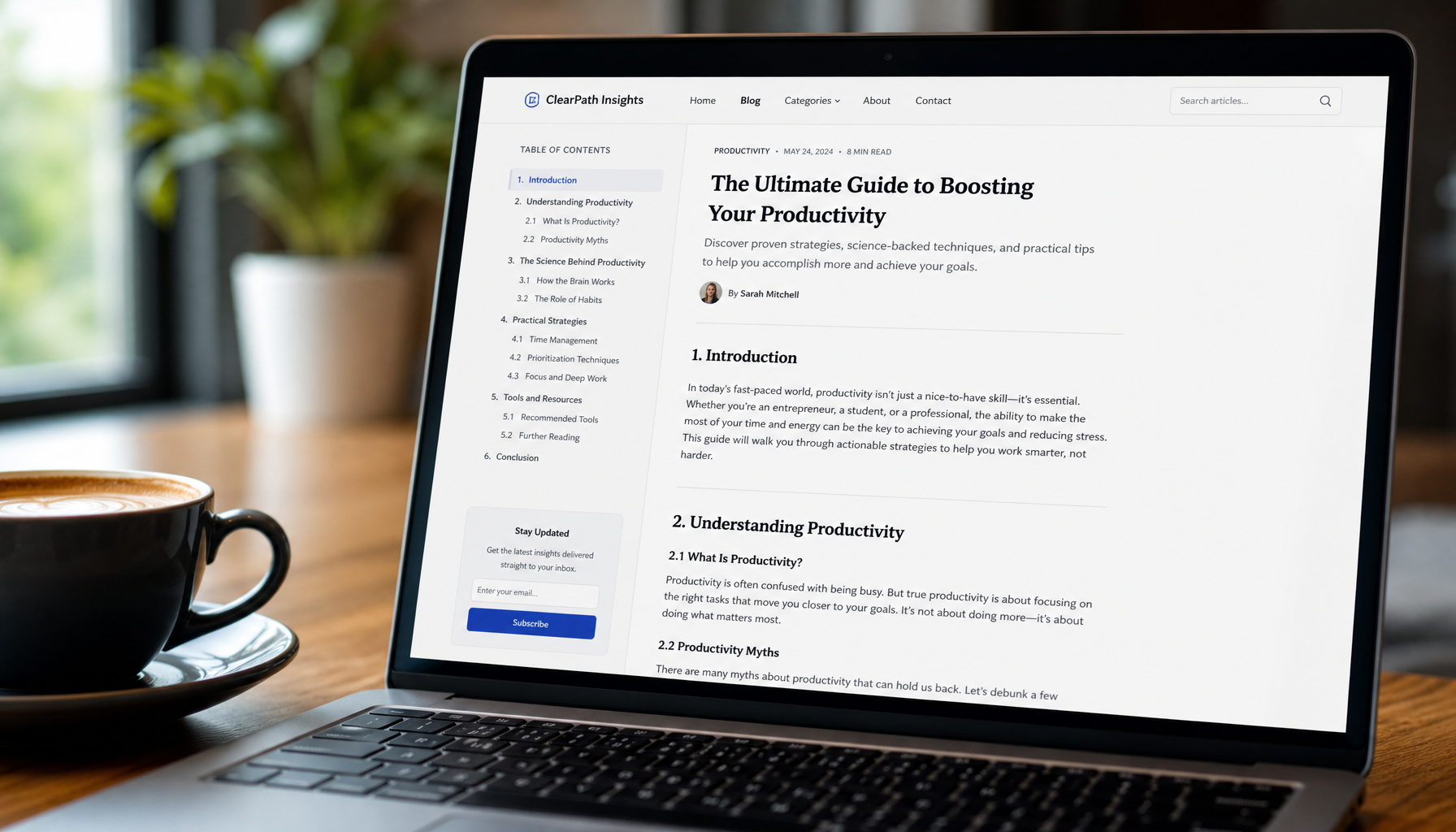
AI engines love lists. Ordered lists, unordered lists, and definition lists all provide clear, extractable information that AI models can easily parse and cite. Here’s why they work so well:
- Clear boundaries: Each list item is a discrete piece of information with obvious start and end points
- Parallel structure: Lists enforce consistent formatting that AI models can process efficiently
- Scannable extraction: AI engines can pull individual items or the entire list depending on the query
- Implicit ranking: Ordered lists signal priority, which helps AI engines understand relative importance
The key is to make each list item substantive enough to stand alone as a useful piece of information. Single-word list items don’t provide enough context for AI citation. Aim for list items that are one to two sentences each, combining the key point with a brief explanation.
The Question-Answer Pattern
This is one of the highest-performing structural patterns for AI citations. When you structure content as explicit questions followed by direct answers, you’re essentially pre-formatting your content for the exact way AI engines serve information to users.
How to Implement Q&A Structure
Use the question as an H2 or H3 heading, then provide the answer immediately in the first paragraph below. Don’t add preamble or context before the answer. The AI engine is looking for the most direct response to match against user queries.
Example structure:
- H3: “How long should content be for AI citation?”
- First paragraph: Direct answer (2-3 sentences)
- Following paragraphs: Supporting evidence, examples, nuance
FAQ Sections as Citation Magnets
Adding a dedicated FAQ section at the end of your content serves dual purposes. First, it captures long-tail queries that your main content might not address directly. Second, it provides AI engines with pre-formatted question-answer pairs that are trivially easy to cite.
Combine your FAQ section with proper FAQ schema markup to maximize visibility. AI engines that process structured data will have even higher confidence in citing your FAQ answers because the schema provides explicit semantic context.
The Evidence-Backed Claims Pattern
AI engines are increasingly sophisticated about evaluating source credibility. Content that makes claims without supporting evidence gets cited less frequently than content that follows a claim-evidence-source pattern.
The Claim-Evidence Structure
- State the claim clearly: “Pages with FAQ schema receive 35% more AI citations”
- Provide the evidence: Describe the study, data, or methodology
- Cite the source: Link to or reference the original research
This pattern works because AI engines need to assess the reliability of information before citing it. When you provide evidence and sources, you reduce the AI’s uncertainty about whether your claim is accurate. The AI can cross-reference your sources and gain confidence in citing your content.

The Comparison Table Pattern
When users ask AI engines to compare options, the AI looks for content that presents comparisons in a structured, balanced format. HTML tables are particularly effective because they provide clear, parseable comparison data.
Effective comparison tables include:
- Clear column headers that identify what’s being compared
- Consistent criteria across all options
- Specific data points rather than vague qualitative assessments
- A summary row or paragraph that synthesizes the comparison
For example, if you’re comparing GEO tools, don’t just say one is “better.” Provide specific metrics: number of dimensions analyzed, pricing tiers, API availability, and accuracy scores. This structured data gives AI engines concrete information to cite.
The Progressive Depth Pattern
This pattern structures content to serve multiple levels of user intent within a single page. It works by providing increasingly detailed information as the reader progresses through the content.
Level 1: Executive Summary (First 200 Words)
Open with a comprehensive summary that answers the primary query in 2-3 paragraphs. This serves users (and AI engines) that need a quick, authoritative answer. Many AI citations pull from this opening section because it provides complete, concise information.
Level 2: Detailed Explanation (Middle Sections)
Expand each point from the summary into full sections with examples, data, and practical guidance. This serves more complex queries where the AI needs detailed information to construct a comprehensive response.
Level 3: Expert-Level Detail (Deep Sections)
Include technical details, edge cases, and advanced strategies for expert-level queries. This positions your content as the definitive resource on the topic, increasing the likelihood of citation for specialized questions.
The Semantic Chunking Pattern
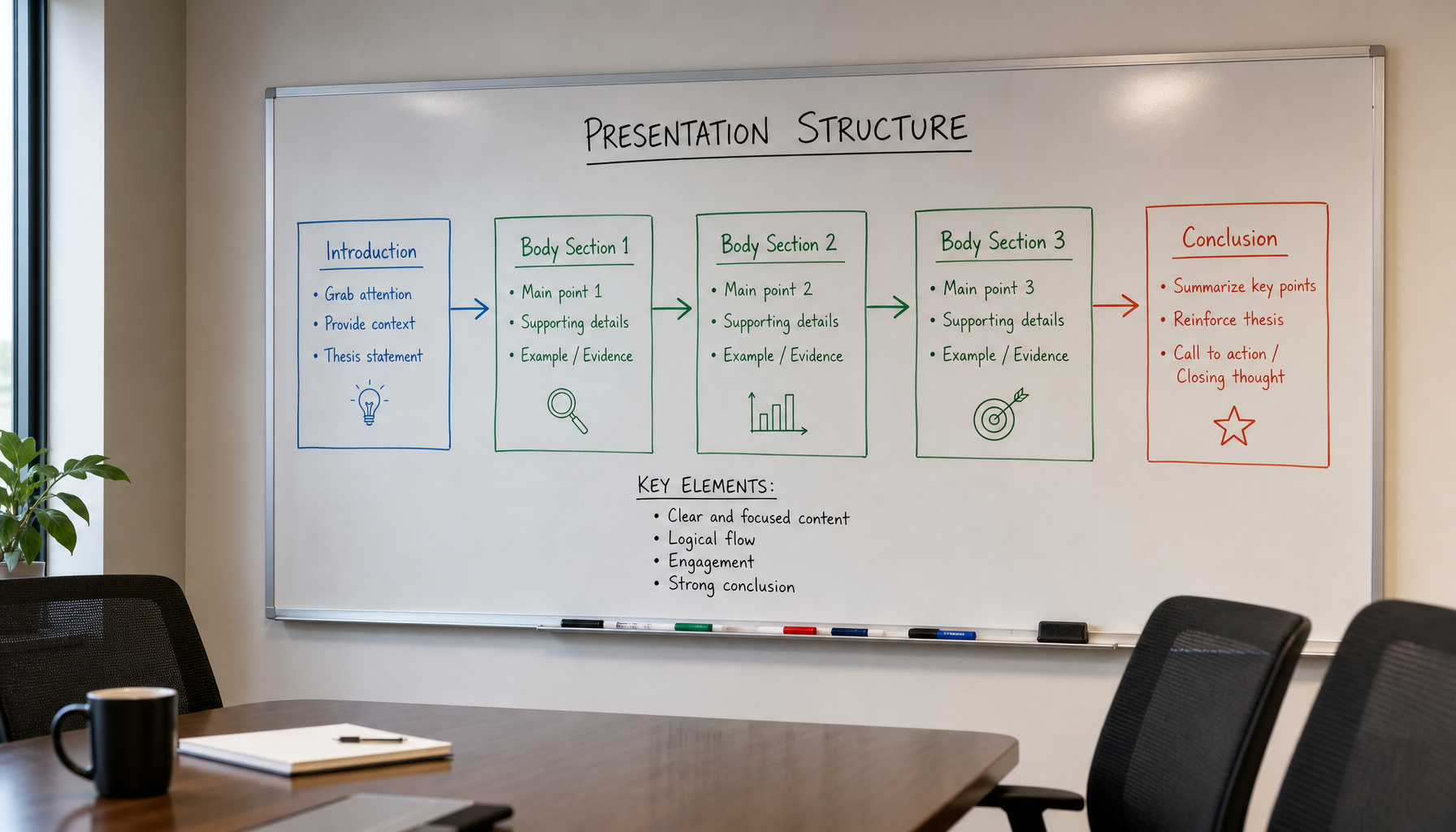
AI engines process content in chunks, not as continuous text. Optimizing your content for semantic chunking means ensuring each section is self-contained enough to be cited independently while still contributing to the overall narrative.
What Makes a Good Semantic Chunk
- Self-contained meaning: The chunk makes sense without requiring context from other sections
- Clear topic boundary: Each chunk addresses one specific subtopic
- Appropriate length: 150-300 words per chunk is optimal for AI extraction
- Internal coherence: The chunk follows a logical flow from premise to conclusion
Paragraph Length Optimization
Keep paragraphs between 3-5 sentences. Single-sentence paragraphs lack enough context for meaningful citation. Paragraphs longer than 5 sentences often contain multiple ideas that should be separated, making it harder for AI engines to extract specific information.
Each paragraph should ideally contain one main idea, supported by evidence or explanation. This makes it easy for AI engines to identify the key point and decide whether it’s relevant to a user’s query.
The Internal Linking Structure Pattern
Internal links serve a different purpose in GEO than in traditional SEO. While traditional SEO uses internal links primarily for PageRank distribution, AI engines use internal links to understand topical relationships and content depth.
Effective internal linking for AI citation includes:
- Contextual links within paragraphs that connect related concepts across your site
- Descriptive anchor text that tells AI engines what the linked page covers
- Hub-and-spoke structures where pillar content links to detailed subtopic pages
- Breadcrumb-style navigation that establishes topical hierarchy
When AI engines crawl your site and find a well-connected internal linking structure, they gain confidence that your site has comprehensive coverage of the topic. This topical authority signal increases citation likelihood across all your related pages. Check your current GEO Score to see how your internal linking structure performs.
The Freshness Signal Pattern
AI engines prioritize current information, especially for topics that evolve rapidly. Structuring your content with clear freshness signals helps AI engines determine whether your information is still relevant.
Date-Stamped Sections
Include publication dates and last-updated dates prominently. When you update content, add a visible “Last updated: [date]” marker. AI engines use these signals to assess whether your information is current enough to cite.
Temporal Context in Content
Reference specific time periods in your content: “As of May 2026,” or “In Q1 2026 data shows.” This helps AI engines understand the temporal relevance of your claims and cite them appropriately for time-sensitive queries.
Version History
For rapidly evolving topics, consider including a brief changelog or version history. This signals to AI engines that your content is actively maintained and reflects the latest information.
Measuring Structure Effectiveness with GEO Score
Understanding whether your content structure is optimized for AI engines requires measurement. The Openbyt GEO Score Analyzer evaluates your content across 9 dimensions, including structural organization, semantic clarity, and citation readiness.
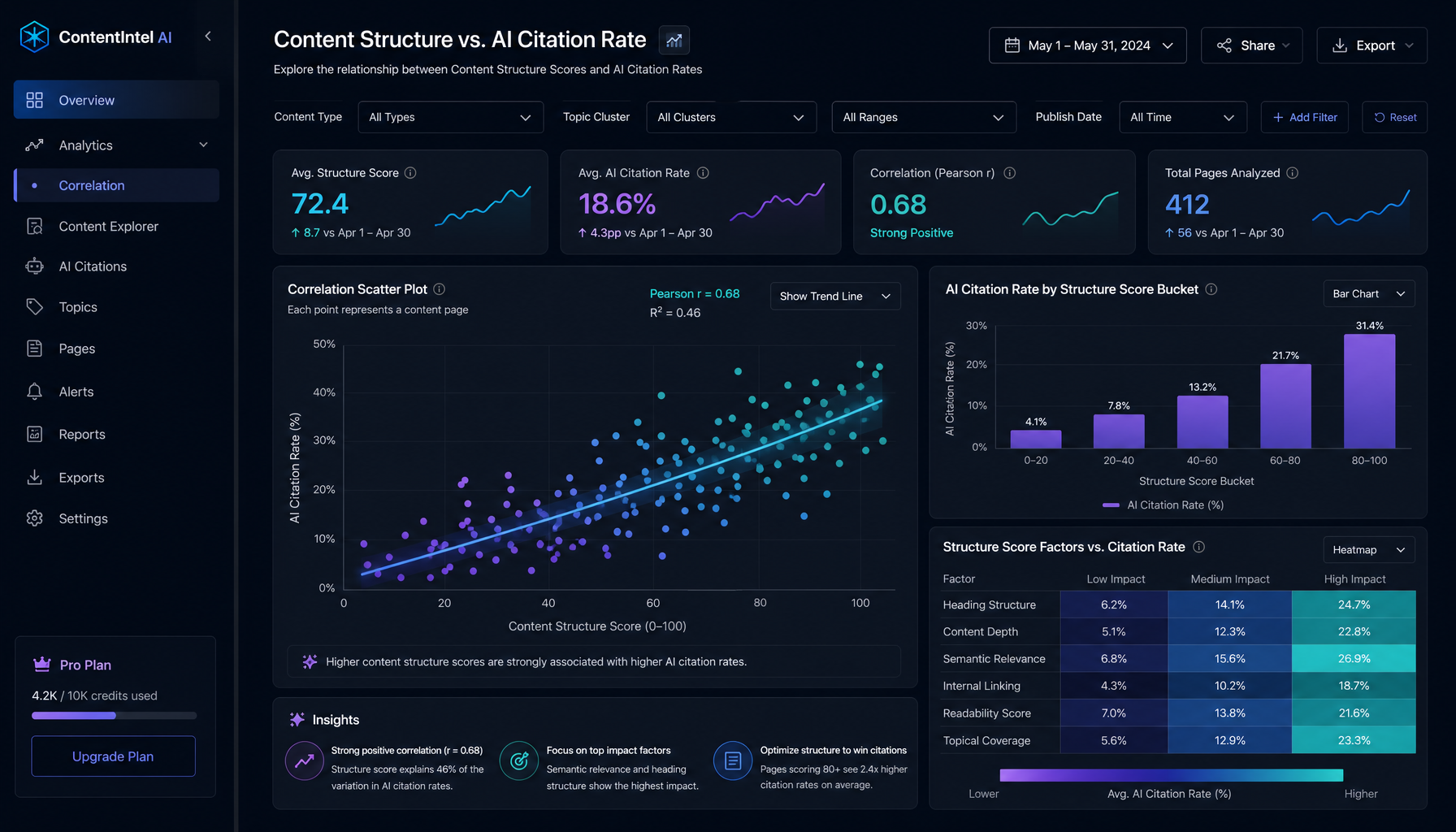
Key metrics to track include:
- Heading hierarchy score: Are your headings properly nested and descriptive?
- Chunk quality score: Are your content sections self-contained and extractable?
- List and table usage: Are you using structured elements where appropriate?
- Definition clarity: Do you lead with clear definitions for key concepts?
- Evidence density: Are your claims supported with data and sources?
Regular measurement helps you identify structural weaknesses before they cost you AI citations. The Pro plan gives you 50 analyses per day, enough to audit your entire content library and track improvements over time.
Putting It All Together: A Content Structure Template
Here’s a practical template that combines all the patterns discussed above into a single, AI-optimized content structure:
- Title (H1): Descriptive, query-matching title
- Executive summary: 2-3 paragraphs answering the primary query
- Definition section: Clear definitions of key terms
- Main body sections (H2s): Each covering one major subtopic
- Subsections (H3s): Breaking complex topics into granular chunks
- Evidence and data: Supporting claims with sources
- Comparison tables: Where relevant for multi-option queries
- Practical examples: Real-world applications of concepts
- FAQ section: 3-5 common questions with direct answers
- Conclusion with CTA: Summary and next steps
This template isn’t rigid. Adapt it to your specific topic and audience. The key principle is that every structural choice should make it easier for AI engines to find, understand, and cite your content.
Frequently Asked Questions
What is the ideal content length for AI engine citations?
AI engines don’t have a strict word count preference, but comprehensive content between 2,500-4,000 words tends to perform best. This length allows you to cover a topic thoroughly with proper structure, multiple semantic chunks, and supporting evidence. Shorter content often lacks the depth needed for AI engines to consider it authoritative, while extremely long content can dilute focus.
Do AI engines prefer bullet points or numbered lists?
Both formats work well, but they serve different purposes. Use numbered lists when order or priority matters (steps in a process, ranked recommendations). Use bullet points for unordered collections of related items. The key factor is that each list item should be substantive enough to provide standalone value, typically one to two sentences combining the point with a brief explanation.
How often should I update content structure for GEO?
Review and update your content structure quarterly at minimum. AI engines re-crawl and re-evaluate content regularly, and structural improvements may help citation readiness after recrawling, but timing varies. Use the GEO Score tool to identify which pages need structural updates and prioritize based on traffic potential.
Can too much structure hurt AI citations?
Yes, over-structuring can be counterproductive. If every sentence has its own heading, or if you use lists where prose would be more natural, the content becomes fragmented and loses coherence. AI engines evaluate both structure and readability. The goal is clear organization that serves comprehension, not mechanical formatting that sacrifices natural flow.
Should I use tables for all comparisons?
Tables work best when you’re comparing three or more items across multiple consistent criteria. For simple two-option comparisons, well-structured prose with clear contrast language often works better. AI engines can extract comparison information from both formats, but tables provide clearer parsing for complex multi-variable comparisons.
Start Optimizing Your Content Structure Today
Content structure is one of the highest-leverage improvements you can make for AI search visibility. Unlike building backlinks or establishing domain authority, structural optimization can be implemented immediately and can be reviewed after recrawling.
Ready to see how your content structure measures up? Try the free Openbyt GEO Score Analyzer to get an instant evaluation of your content across all 9 optimization dimensions. You’ll get specific, actionable recommendations for improving your structure and increasing your AI citation rate. Three free analyses per day, no credit card required.